Dosage and administration
The usual clinical schedule for travoprost eye drops is one drop in the affected eye or eyes once daily, commonly in the evening. Use the regimen confirmed for your prescription rather than adding extra drops when pressure control seems inadequate.
Apply the drops in this order:
- Wash and dry your hands.
- Remove contact lenses before application.
- Tilt your head back and gently pull down the lower eyelid.
- Place one drop into the pocket between the eyelid and eye.
- Avoid touching the eye, eyelashes, or skin with the bottle tip.
- Close the eye gently without squeezing the eyelids.
- Press a clean finger lightly against the inner corner of the closed eye for about one minute.
- Replace contact lenses only after the interval specified for your formulation.
Punctal occlusion means gently pressing the inner corner of the eye after application. This reduces drainage through the tear duct and may limit absorption into the bloodstream. The technique is useful when a person develops a bitter taste, watery eyes, or systemic symptoms after eye-drop use.
A drop that lands on the cheek has not necessarily reached the eye. Wipe excess liquid from the skin, but do not repeat the dose automatically because two drops can increase irritation without improving pressure control.
If another ophthalmic medicine is used, leave at least five minutes between products. Eye ointments are generally applied after liquid drops. Missing one dose usually means applying the next scheduled dose at the normal time; do not double the amount.
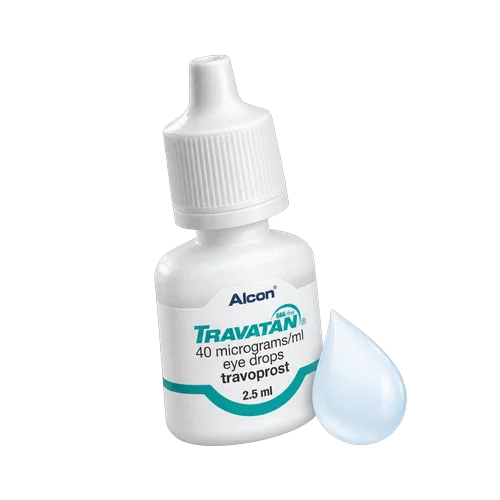
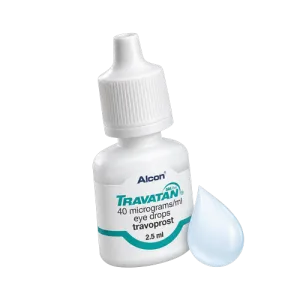
One bottle should be handled carefully. The tip must remain clean, and the solution should not be transferred to another container. Travatan is intended for ocular use only.
Keep the bottle tip away from all surfaces.
Reasons not to use it
- Allergy to travoprost or any component of the ophthalmic solution
- Active eye infection or significant inflammation
- Previous uveitis or recurrent intraocular inflammation
- Aphakia or absence of the natural lens
- A damaged or absent posterior lens capsule
- Macular-oedema history or significant risk of cystoid macular oedema
- Recent eye surgery
- Contact-lens use
- Pregnancy or breastfeeding
- Use of several pressure-lowering eye medicines
Travoprost may worsen intraocular inflammation in susceptible patients. People with a history of keratitis, uveitis, or macular oedema require closer ophthalmic supervision.
Topical nonsteroidal anti-inflammatory drugs can affect corneal healing and may increase concern about macular oedema in predisposed eyes. This is a clinical precaution rather than a reason to stop prescribed treatment without direction. Tell the prescriber about eye drops containing an NSAID, especially after eye surgery.
Travoprost has limited systemic exposure when used correctly, but punctal occlusion may reduce absorption further. The product is not intended for injection, oral use, or application to the skin.
When this is not for you
Travatan is not suitable for everyone. Travatan is NOT for you if a clinician has confirmed an allergy to travoprost or an ingredient. Active eye infection or significant inflammation can require a different plan. Recent eye surgery may change the timing of treatment. Pregnancy or breastfeeding calls for individualized advice.
Facial swelling, widespread rash, breathing difficulty, or severe eyelid swelling requires urgent medical attention. New distortion, a central blurred area, or a noticeable decline in reading vision should be assessed promptly.
Possible side effects
Eye redness is one of the most recognizable effects of travoprost. It occurs because the medicine can increase blood flow in the conjunctival vessels. Mild redness may settle as treatment continues, but persistent or painful redness needs clinical assessment.
Other reported effects include:
- Burning, stinging, or itching after application
- Watery eyes
- Dry-eye symptoms
- Foreign-body sensation
- Temporary blurred vision
- Eyelid swelling
- Darkening of the skin around the eye
- Increased eyelash length, thickness, or pigmentation
- Headache or unpleasant taste
Travoprost may gradually increase brown pigmentation in the iris. This change can be permanent, especially in eyes with mixed green-brown, blue-brown, or grey-brown colouring. The colour change may develop slowly and may be more noticeable when only one eye receives treatment.
Eyelash changes can also persist while treatment continues. Some patients appreciate fuller lashes; others notice uneven growth between the treated and untreated eyes. These cosmetic effects are not a sign that the medicine is working better.
Seek prompt eye assessment for marked eye pain, sudden vision reduction, pronounced light sensitivity, new floaters, or severe swelling. These symptoms can indicate a condition requiring more than routine management of mild drop irritation. The FDA prescribing information describes ocular redness, iris pigmentation, and eyelash changes among recognized effects of travoprost ophthalmic therapy [2].
Do not judge treatment by redness alone. Mild redness can occur with travoprost, while a painful red eye with reduced vision requires a different level of attention.
Therapeutic indications
Travatan is used for:
- Open-angle glaucoma
- Ocular hypertension
- Pressure control when another glaucoma treatment does not provide enough reduction
- Treatment plans requiring a once-daily prostaglandin analogue
Glaucoma can progress without pain or obvious early symptoms. Lowering intraocular pressure helps protect the optic nerve, but it does not restore vision already lost from glaucoma. Health Canada recognizes travoprost ophthalmic therapy as a pressure-lowering treatment for appropriate patients [1].
Travatan is supplied as an ophthalmic solution in a bottle. The prescribed regimen for the selected strength should be confirmed with a healthcare professional before starting.
Travatan lowers eye pressure even when vision feels unchanged. Keep scheduled eye-pressure checks because symptom relief is not a reliable measure of treatment success.
Comparison
Travatan belongs to the prostaglandin-analogue group. Other glaucoma treatments work through different pathways, and an eye specialist may choose one approach based on pressure targets, inflammation history, breathing conditions, heart rate, ocular-surface tolerance, and previous response.
| Treatment approach |
Main pressure-lowering pathway |
Practical distinction |
| Travoprost ophthalmic drops |
Increase uveoscleral fluid outflow |
Commonly used once daily; iris and eyelash changes can occur |
| Other prostaglandin analogues |
Increase uveoscleral fluid outflow |
Similar class benefits, with differences in tolerability and formulation |
| Beta-blocker eye drops |
Reduce aqueous-humour production |
May affect pulse or breathing and can be unsuitable for some patients |
| Carbonic-anhydrase-inhibitor eye drops |
Reduce aqueous-humour production |
May cause stinging or a bitter taste and may require more frequent dosing |
Travoprost and other prostaglandin analogues share a pressure-lowering mechanism, but they are not interchangeable by assumption. The inactive ingredients and preservative systems can differ, affecting burning, redness, or dry-eye symptoms.
Beta-blocker drops may be less suitable for people with asthma, certain conduction problems, or a slow heart rate. Carbonic-anhydrase inhibitors may be selected when a different mechanism is needed or when additional pressure reduction is required. The treatment decision depends on the individual eye-pressure target and the condition of the optic nerve.
Common mistakes
Several practical errors can reduce the amount of Travatan reaching the eye:
- Applying extra drops after a missed dose
- Touching the bottle tip to the eye or eyelashes
- Using the drops while contact lenses remain in place
- Applying several eye drops immediately one after another
- Stopping treatment because vision feels normal
- Pressing the eyelids tightly shut after application
- Failing to mention prior eye inflammation or macular oedema
- Treating persistent painful redness as a minor cosmetic effect
- Sharing the bottle with another person
- Using Travatan in the wrong eye after a complicated dosing schedule
One extra drop does not produce twice the pressure-lowering benefit. It can increase surface irritation and leave less solution for later use.
Some patients confuse a temporary sting with proof that the medicine has reached the eye. Stinging can occur, but the more useful technique is a controlled drop followed by gentle eyelid closure and punctal occlusion.
If several eye medicines are prescribed, keep a written sequence with separate times. A five-minute gap prevents the next drop from washing the first one out of the eye.
What doctors say
In clinical practice, doctors often judge Travatan by three measures: intraocular pressure, optic-nerve appearance, and visual-field stability. A patient may feel no difference while the medicine is protecting long-term eye function.
A common mistake is expecting clearer vision after starting a pressure-lowering drop. Travatan controls a risk factor; it does not sharpen vision in the way corrective lenses do. The treatment goal is pressure control and preservation of remaining sight.
Eye specialists may continue Travatan when pressure falls adequately and the ocular surface remains comfortable. They may change treatment when redness is persistent, inflammation develops, the pressure target is not reached, or the patient cannot maintain the dosing routine.
The World Health Organization identifies glaucoma as a major cause of irreversible vision loss, which is why regular monitoring remains part of treatment even when the drops seem uneventful [3].