How it affects the body
Bimatoprost improves aqueous humour outflow through two routes:
- the trabecular meshwork, which provides the conventional drainage pathway;
- the uveoscleral pathway, which allows fluid to pass through tissues around the ciliary body.
This action lowers pressure without reducing the amount of fluid needed for normal eye function. The effect is local, so the drops are placed directly into the affected eye or eyes.
The term “prostamide” describes the pharmacological family to which bimatoprost belongs. Its activity overlaps with prostaglandin-related medicines, yet its receptor interactions and tolerability profile are not identical to those of every other eye-pressure treatment. Clinical use focuses on pressure control, not on improving blurred vision caused by unrelated eye conditions.
If you use more than one eye drop, separate the products by at least five minutes. This prevents the second drop from washing the first one out of the eye.
Dosage and administration
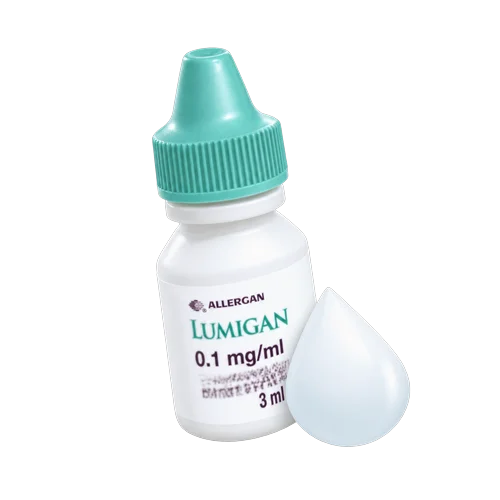
The product form is a 3 ml bottle of Lumigan 0.1 mg/ml ophthalmic solution. The prescribed amount is selected for the individual patient rather than being one fixed amount for everyone.
For the 0.01% ophthalmic solution, the usual labelled schedule is administration once daily in the evening. More frequent use can reduce the pressure-lowering response, so increasing the frequency does not provide a simple extra benefit. The Health Canada product monograph describes the standard ophthalmic administration and relevant precautions [2].
Use the drops as follows:
- Wash and dry your hands.
- Remove contact lenses before applying the drops.
- Tilt your head back and gently pull down the lower eyelid.
- Place the prescribed amount into the conjunctival pocket without touching the eye, eyelid, eyelashes, or surrounding skin with the bottle tip.
- Close the eye gently for about one minute.
- Press lightly against the inner corner of the closed eye if your prescriber has recommended punctal occlusion.
- Replace contact lenses after at least 15 minutes.
The bottle tip should remain clean. Touching it to the eyelashes is a common way to contaminate an ophthalmic solution.
Apply the evening dose at the same part of your routine, such as after brushing your teeth. A stable routine makes missed applications less likely.
If a dose is missed, apply it when remembered unless the next scheduled dose is approaching. Skip the missed dose when the next one is due soon. Do not apply extra drops to compensate.
Reasons not to use it
Lumigan is not for you if you have a known hypersensitivity to bimatoprost or any component of the ophthalmic solution. A previous serious allergic reaction to an eye drop requires specific review before treatment.
Caution is needed in the following situations:
- active eye inflammation, such as uveitis or significant intraocular inflammation;
- macular oedema or a history of macular oedema;
- aphakia or absence of the natural lens;
- a damaged or absent posterior lens capsule;
- severe dry-eye disease;
- a history of herpetic eye disease;
- recent eye surgery;
- asthma or respiratory disease when other pressure-lowering medicines are also being considered.
Bimatoprost can interact clinically with other intraocular-pressure-lowering treatments. Using multiple prostaglandin analogues together may paradoxically raise intraocular pressure or reduce the expected response. The EMA product information also describes precautions involving intraocular inflammation and macular changes [4].
Pregnancy and breastfeeding require an individual risk assessment. Bimatoprost may theoretically affect uterine activity or a breastfed infant, while direct human safety data remain limited.
When this is not for you
Talk to your clinician before using Lumigan if you have had a serious reaction to eye drops, eye inflammation, macular oedema, recent eye surgery, severe dry eyes, or herpetic eye disease. Extra review is also important during pregnancy or breastfeeding, and if you already use several glaucoma drops.
Possible side effects
Bimatoprost is often tolerated well, but local eye reactions can occur. The Canadian product information identifies conjunctival hyperemia, which appears as eye redness, among the recognised adverse effects. The same source describes changes involving the iris, eyelashes, eyelids, and skin around the eye [3].
Common or clinically relevant reactions include:
- eye redness or irritation;
- itching, dryness, or a foreign-body sensation;
- increased tearing;
- darkening of the iris, which may be permanent;
- longer, thicker, or darker eyelashes;
- darkening of the skin around the eyes;
- changes in the fat tissue around the eye, sometimes called prostaglandin-associated periorbitopathy;
- blurred vision immediately after application.
Cosmetic changes may develop gradually. Iris pigmentation is more noticeable in people with mixed-colour irises and may persist after treatment stops. Eyelash changes usually affect the treated eye more strongly when only one eye receives treatment, which can create visible asymmetry.
Seek urgent eye assessment for severe eye pain, marked light sensitivity, sudden visual loss, pronounced swelling, a new rash around the eye, or symptoms suggesting an acute allergic reaction. A small amount of temporary blurring can occur after a drop, but persistent or severe visual disturbance requires prompt attention.
A clean tissue can remove excess liquid from the cheek after application. Avoid rubbing the eyelid, because repeated rubbing may worsen irritation and spread the solution onto nearby skin.
Comparison
Several ophthalmic medicines lower intraocular pressure through prostaglandin-related pathways. The choice depends on pressure targets, response, eye-surface tolerance, dosing preferences, inflammation history, and previous treatment.
| Active ingredient |
Main pharmacological role |
Common clinical consideration |
| Bimatoprost |
Prostamide analogue that increases trabecular and uveoscleral outflow |
Redness, eyelash changes, and iris pigmentation may occur |
| Latanoprost |
Prostaglandin F2α analogue that increases uveoscleral outflow |
Often used once daily; iris pigmentation and eyelash changes are possible |
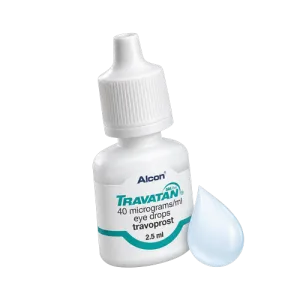
| Travoprost |
Prostaglandin analogue that increases uveoscleral outflow |
Redness and pigmentary changes may occur; tolerability varies |
Bimatoprost, latanoprost, and travoprost can all provide sustained pressure reduction with once-daily administration. Their molecular targets overlap, but patients can respond differently to each one. One person may experience more redness with bimatoprost, while another may find its pressure response preferable.
Combining two prostaglandin-type drops is not a routine way to obtain extra pressure control. Treatment plans may instead combine different drug classes, such as a beta blocker, carbonic anhydrase inhibitor, or alpha-adrenergic agonist, when one agent does not achieve the desired pressure.
The decision should be based on measured intraocular pressure, optic-nerve findings, visual-field results, and tolerability rather than on the product name alone.
Common mistakes
Several practical errors can reduce the amount of medicine reaching the eye or increase irritation:
- applying extra drops after a missed dose;
- using Lumigan more than once daily without a specific instruction;
- touching the bottle tip to the eyelashes or eye surface;
- placing several eye drops in the eye within seconds of one another;
- rubbing the eyelids after application;
- forgetting to remove contact lenses;
- stopping because of mild redness without discussing a treatment adjustment;
- using the same bottle for another person;
- confusing a skin or eyelash application with the prescribed ophthalmic use;
- failing to mention previous macular oedema or eye surgery.
A drop placed on the cheek is not necessarily a failed dose. Excess liquid can be gently removed from the skin, while forceful rubbing should be avoided.
Do not compensate for an omitted dose with several drops. The amount per intake is determined individually, and extra solution can increase exposure without reliably improving pressure control.
What doctors say
In clinical practice, ophthalmologists usually judge Lumigan by pressure measurements and optic-nerve stability rather than by how the eyes feel. Glaucoma can progress silently, so an absence of discomfort does not prove that pressure is controlled.
A practical clinical goal is consistent use at the prescribed interval. Missing several evening doses can make pressure readings appear higher at follow-up and may lead to unnecessary treatment changes. Doctors also assess visual fields, optic-disc appearance, retinal-nerve-fibre-layer measurements, and the patient’s experience of redness or dryness.
One important point is that pressure improvement may begin within hours, while the treatment plan is judged over repeated measurements. The first follow-up result does not always show the full long-term pattern.
Patients sometimes stop when their eyes look red. Redness can be a known local reaction, but stopping without a replacement plan may allow pressure to rise again. The appropriate response depends on severity, persistence, and the condition of the optic nerve.
The WHO’s technical guidance on glaucoma care supports early pressure control and continued monitoring because optic-nerve damage can become irreversible [5].