I took the weekly 70 mg tablet before breakfast and used a calendar reminder. After several months, my follow-up bone scan showed improvement, and the routine became easy once I kept the tablet beside a glass of water.
Edmonton Several months Nov 12, 2026
Fosamax
Alendronate slows the breakdown of bone, helping Fosamax increase bone mineral density and lower fracture risk. It is used for osteoporosis in postmenopausal women and men, and for selected cases of…
Alendronate slows the breakdown of bone, helping Fosamax increase bone mineral density and lower fracture risk. It is used for osteoporosis in postmenopausal women and men, and for selected cases of Paget’s disease of bone.
Overview
Fosamax contains alendronate sodium, a bisphosphonate that reduces excessive bone resorption. Bone resorption is the natural removal of older bone tissue; osteoporosis develops when breakdown outpaces new bone formation for a prolonged period. Alendronate is used to treat osteoporosis and help prevent further bone loss. It is also used for Paget’s disease, a condition in which bone remodelling becomes unusually rapid and disorganized. These conditions require different treatment goals and follow-up plans.
The tablet is intended for oral use. The dose is decided individually, taking age, other medicines, and health conditions into account. Health Canada identifies alendronate as a bisphosphonate for osteoporosis management and related bone disorders [1].
Pharmacological class and action
Bisphosphonates attach to mineralized bone surfaces. When osteoclasts begin removing bone, alendronate interferes with their activity and survival. This lowers bone turnover and gives osteoblasts more opportunity to maintain bone strength.
The medicine does not rebuild a fracture immediately. Its benefit develops through sustained reduction in bone loss and gradual improvement in bone mineral density. Bone turnover markers may fall before changes are seen on a bone-density scan.
How it affects the body
Bisphosphonates attach to mineralized bone surfaces. When osteoclasts begin removing bone, alendronate interferes with their activity and survival. This lowers bone turnover and gives osteoblasts more opportunity to maintain bone strength.
The medicine does not rebuild a fracture immediately. Its benefit develops through sustained reduction in bone loss and gradual improvement in bone mineral density. Bone turnover markers may fall before changes are seen on a bone-density scan.
Formulation
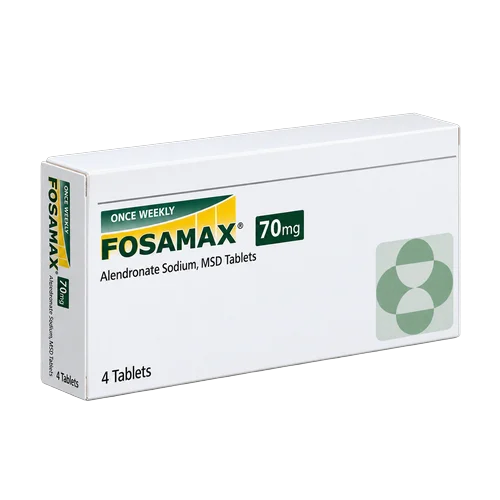
Fosamax contains alendronate sodium as its active substance. The pack is marked FOSAMAX, Alendronate Sodium, and contains four tablets.
Dosage and administration
Fosamax is commonly taken once weekly for osteoporosis. The dose is decided individually, taking age, other medicines, and health conditions into account. The tablet must be swallowed whole rather than crushed, chewed, or allowed to dissolve in the mouth.
Use these administration steps:
- Choose one consistent morning each week.
- Take the tablet after getting up, before breakfast or any other oral medicine.
- Swallow it with a full glass of plain water.
- Remain sitting or standing for at least 30 minutes.
- Do not lie down until after the 30-minute period and the first meal of the day.
- Avoid mineral water, coffee, juice, milk, and other drinks for the initial dose interval.
- Do not take calcium, iron, magnesium, antacids, or other oral medicines at the same time.
The upright position reduces contact between alendronate and the oesophagus. Incorrect administration can cause heartburn, pain on swallowing, inflammation, or ulceration. The Canadian product information gives the same morning and posture precautions [2].
If a weekly dose is missed, take it on the morning after it is remembered. Do not take two tablets on the same day. The next dose should return to the usual chosen day.
Reasons not to use it
- An abnormality of the oesophagus that delays emptying, such as a stricture or achalasia.
- Inability to remain upright for at least 30 minutes.
- Low blood calcium that has not been corrected.
- Previous serious allergic reaction to alendronate or one of its components.
- Significant kidney impairment where the prescriber considers bisphosphonate treatment unsuitable.
- Active upper gastrointestinal symptoms that make swallowing or oesophageal healing a concern.
When this is not for you
Fosamax is not for you if you cannot remain upright for 30 minutes, have an oesophageal emptying disorder, or have untreated low calcium. It should not be used when any of the following applies unless a specialist has established a different plan:
- An abnormality of the oesophagus that delays emptying, such as a stricture or achalasia.
- Inability to remain upright for at least 30 minutes.
- Low blood calcium that has not been corrected.
- Previous serious allergic reaction to alendronate or one of its components.
- Significant kidney impairment where the prescriber considers bisphosphonate treatment unsuitable.
- Active upper gastrointestinal symptoms that make swallowing or oesophageal healing a concern.
Possible side effects
Alendronate is often tolerated without major problems, yet its administration rules matter because the upper digestive tract is exposed directly to the tablet. Mild symptoms can include abdominal discomfort, indigestion, acid reflux, nausea, constipation, diarrhoea, muscle pain, joint pain, or headache.
Digestive symptoms deserve attention when they are persistent or worsening. Severe heartburn, chest pain, pain or difficulty when swallowing, or new pain behind the breastbone can indicate oesophageal irritation. These symptoms require prompt medical assessment and further doses should not be taken until the prescriber has reviewed the situation.
Musculoskeletal pain can occur during treatment. Some patients describe aching in the thighs, hips, back, or joints. Persistent thigh or groin pain may precede an atypical femur fracture, a rare complication associated with prolonged bisphosphonate exposure. The FDA prescribing information describes this warning and recommends assessment of unexplained thigh or groin pain [3].
Osteonecrosis of the jaw is uncommon. Risk is higher with invasive dental procedures, cancer treatment, corticosteroids, poor oral health, smoking, and intensive intravenous bisphosphonate therapy. A loose tooth, gum swelling, exposed jawbone, or a non-healing mouth wound needs dental and medical review.
A small number of people develop eye inflammation, rash, or other hypersensitivity reactions. Facial swelling, breathing difficulty, blistering skin, or widespread rash requires urgent care.

Therapeutic indications
Alendronate is used to treat osteoporosis and help prevent further bone loss. It is also used for Paget’s disease, a condition in which bone remodelling becomes unusually rapid and disorganized.
Comparison
Several pharmacological approaches act on bone through different mechanisms. The appropriate choice depends on fracture history, kidney function, gastrointestinal tolerance, ability to follow oral dosing instructions, menopausal status, and previous treatment response.
| Treatment category | Active substance or class | Typical clinical role |
|---|---|---|
| Oral bisphosphonate | Alendronate or risedronate | Reduces osteoclast-mediated bone resorption |
| Injectable antiresorptive | Denosumab | Blocks RANKL signalling and reduces osteoclast formation |
| Intravenous bisphosphonate | Zoledronic acid | Provides periodic antiresorptive treatment when oral therapy is unsuitable |
| Bone-forming therapy | Teriparatide | Stimulates new bone formation in selected patients at very high fracture risk |
Risedronate is another bisphosphonate and may suit someone who cannot follow alendronate’s administration schedule or who develops upper gastrointestinal symptoms. Zoledronic acid avoids daily or weekly tablets but requires intravenous treatment and monitoring.
Denosumab is administered by injection and has a different discontinuation issue: bone turnover can rise rapidly after a missed or stopped dose unless another treatment is planned. Teriparatide is an anabolic option rather than a conventional antiresorptive, so it is reserved for selected high-risk patients.
A clinician may prefer Fosamax when a person can remain upright after dosing, has no significant oesophageal disorder, and wants an established oral bisphosphonate approach. Its limitation is practical: the weekly routine must be followed precisely, and gastrointestinal symptoms can make it unsuitable. The European Medicines Agency describes alendronate within the bisphosphonate group used to reduce fracture risk in osteoporosis [4].
Common mistakes
Several habits reduce the benefit or increase irritation:
- Taking Fosamax after breakfast instead of before food.
- Swallowing it with coffee, juice, milk, or mineral water.
- Taking calcium or iron at the same time.
- Lying down after swallowing the tablet.
- Crushing or chewing the tablet.
- Doubling the next dose after a missed weekly tablet.
- Stopping treatment after a normal-feeling week because osteoporosis has few symptoms.
- Ignoring new thigh, groin, swallowing, or jaw symptoms.
- Failing to mention prednisone or other corticosteroids.
- Treating a dental extraction as unrelated to bisphosphonate therapy.
What doctors say
In clinical practice, physicians usually focus first on fracture risk, kidney function, calcium and vitamin D status, dental history, and the patient’s ability to follow the morning routine. A person with a previous hip or vertebral fracture may need treatment even when symptoms are absent because osteoporosis itself often causes no warning pain.
Doctors also explain that bone-density improvement is gradual. A person may not feel a daily change, yet the reduction in bone turnover can still lower future fracture risk when treatment is taken consistently. The benefit should be reviewed alongside calcium intake, vitamin D status, exercise, fall prevention, and repeat bone-density testing.
The most common practical failure is not pharmacological resistance. It is taking Fosamax with coffee, breakfast, calcium, or another tablet, or lying down shortly after administration. Physicians may also reassess treatment duration after several years, balancing ongoing fracture risk against rare long-term complications.
Common questions
How long does one Fosamax dose keep working?
The 70 mg dose is designed for once-weekly use in osteoporosis, while alendronate remains associated with bone mineral after it leaves the bloodstream. The antiresorptive effect therefore lasts longer than the time the medicine circulates in plasma. A missed dose should not be replaced with two tablets on one day. Health Canada’s 2023 product information supports weekly administration for the 70 mg osteoporosis regimen.
Which condition rules Fosamax out completely?
A major oesophageal emptying disorder, such as achalasia or a significant stricture, can rule out oral Fosamax because the tablet may remain in contact with the oesophagus. The inability to stay upright for at least 30 minutes is another clear contraindication. Untreated hypocalcemia must also be corrected before treatment. The EMA’s 2022 product information describes these administration-related restrictions for alendronate.
What happens after stopping Fosamax, and is tapering needed?
Fosamax is not usually tapered because alendronate binds to bone and does not require a gradual dose reduction to prevent withdrawal symptoms. Bone turnover can rise gradually after treatment ends, and the duration of residual protection varies between individuals. The decision to stop or take a planned treatment pause depends on fracture risk, treatment duration, bone-density results, and previous fractures. NICE guidance from 2022 supports periodic review rather than an automatic lifelong schedule [5].
What should be discussed with a doctor before starting Fosamax?
Discuss swallowing problems, reflux or oesophageal disease, kidney disease, low calcium or vitamin D, dental surgery, previous thigh pain, and all calcium, iron, antacid, corticosteroid, and osteoporosis medicines. Pregnancy, breastfeeding, and previous reactions to bisphosphonates also affect treatment planning. A clinician may arrange blood tests, a bone-density assessment, or dental review based on individual risk. Health Canada’s 2023 Canadian product information provides the relevant prescribing precautions.
How does Fosamax differ from the closest alternative?
Fosamax contains alendronate, an oral bisphosphonate that suppresses osteoclast activity. Risedronate is another oral bisphosphonate with a related mechanism, while denosumab blocks RANKL through injection and teriparatide stimulates bone formation through an anabolic mechanism. The choice depends on fracture risk, kidney function, digestive tolerance, adherence, and the need for oral or injectable treatment. The WHO’s 2022 guidance describes osteoporosis care as requiring treatment selection according to fracture risk and patient-specific factors.
Do you offer anonymous delivery?
Your order will be securely packed and shipped within 24 hours. This is exactly what your package will look like (images of an actual item sent). It has the size and look of a regular private letter (24x11x0.7 cm) and its contents cannot be seen.
Comparison
Sources
- Health Canada (2023). Product Monograph: FOSAMAX (alendronate sodium).
- Health Canada (2023). Canadian product information for alendronate sodium: dosage, administration, warnings, and precautions.
- U.S. Food and Drug Administration (2024). FOSAMAX (alendronate sodium) Prescribing Information.
- European Medicines Agency (2022). Alendronic acid product information and summary of product characteristics.
- National Institute for Health and Care Excellence (2022). Osteoporosis: assessing the risk of fragility fracture and preventing fragility fractures.
How Buyers Rate Fosamax
Based on 5 reviews
The main benefit was having one morning a week to remember instead of a daily tablet. I took the 70 mg dose before work and stayed upright. After several months, I had no trouble fitting the dose into my schedule.
Sherbrooke Several months Nov 19, 2026Fosamax gave me a clear treatment routine. I took the 70 mg tablet once a week for several months. I noticed no immediate sensation from the medicine, but my later assessment was reassuring and I felt more confident continuing the plan.
Saskatoon Several months Oct 21, 2026The 70 mg tablet helped when taken weekly, although I had mild heartburn during the first few weeks. I became stricter about taking it with plain water and remaining upright, which made the routine easier.
Calgary The first few weeks Oct 27, 2026I found the 70 mg weekly administration rules inconvenient and once took it too close to my morning supplements. After several months, my clinician reviewed the timing, but the treatment was later changed because the digestive symptoms continued.
Guelph Several months Nov 6, 2026